
The 10 Pāramīs
A Collective Path of Practice

In the Buddhist wisdom tradition, the Buddha speaks of crossing to the “other shore” while swimming against the stream.
Phew. I’ve been feeling this lately. Have you?
A desire for freedom—and yet, at times, it can feel like the world is collapsing.
This image of crossing points to liberation… a freedom from certain kinds of suffering. And in this beautiful and dangerous world, I find myself wondering about a collective crossing.
What would it be like if we attuned to this sense of inner freedom together?
If we practiced together, might we also experience a kind of shared or collective freeing?
Within the tradition, there are many teachings that guide us from a self-centered orientation toward a deeper sense of interconnection.
Often, this has been framed as transcending the body or escaping the conditions of this life. Over the years, I’ve found myself questioning and gently deconstructing that view—wondering instead about evolution.
What if, as we access deeper layers of consciousness, we aren’t leaving our humanity behind—but actually evolving within it?
As we begin to recognize the capacity to witness our experience, something opens. We can move more freely in and out of the content of our lives.
And yet… witnessing isn’t the whole story.
What we think, feel, and perceive becomes more malleable. Discernment grows. But learning how to access the witness and remain fully engaged in our human life—that’s the real challenge.
To both transcend and include our humanity requires a deep reworking of our conditioning.
We might begin to celebrate differences more fully as the “other shore” becomes a kind of baseline. And still, the question remains:
How do we live in this wild and chaotic world—moving toward the other shore and back again—until the crossing becomes more seamless?
Until we can be fluid in our perspectives: I am. We are. It is.
A kind of shape-shifting in identity… where what is centered in experience can change.
So how do we cultivate this kind of freedom?
Recently, I was walking through Haarlem in the Netherlands when the bells of the great church began to chime.
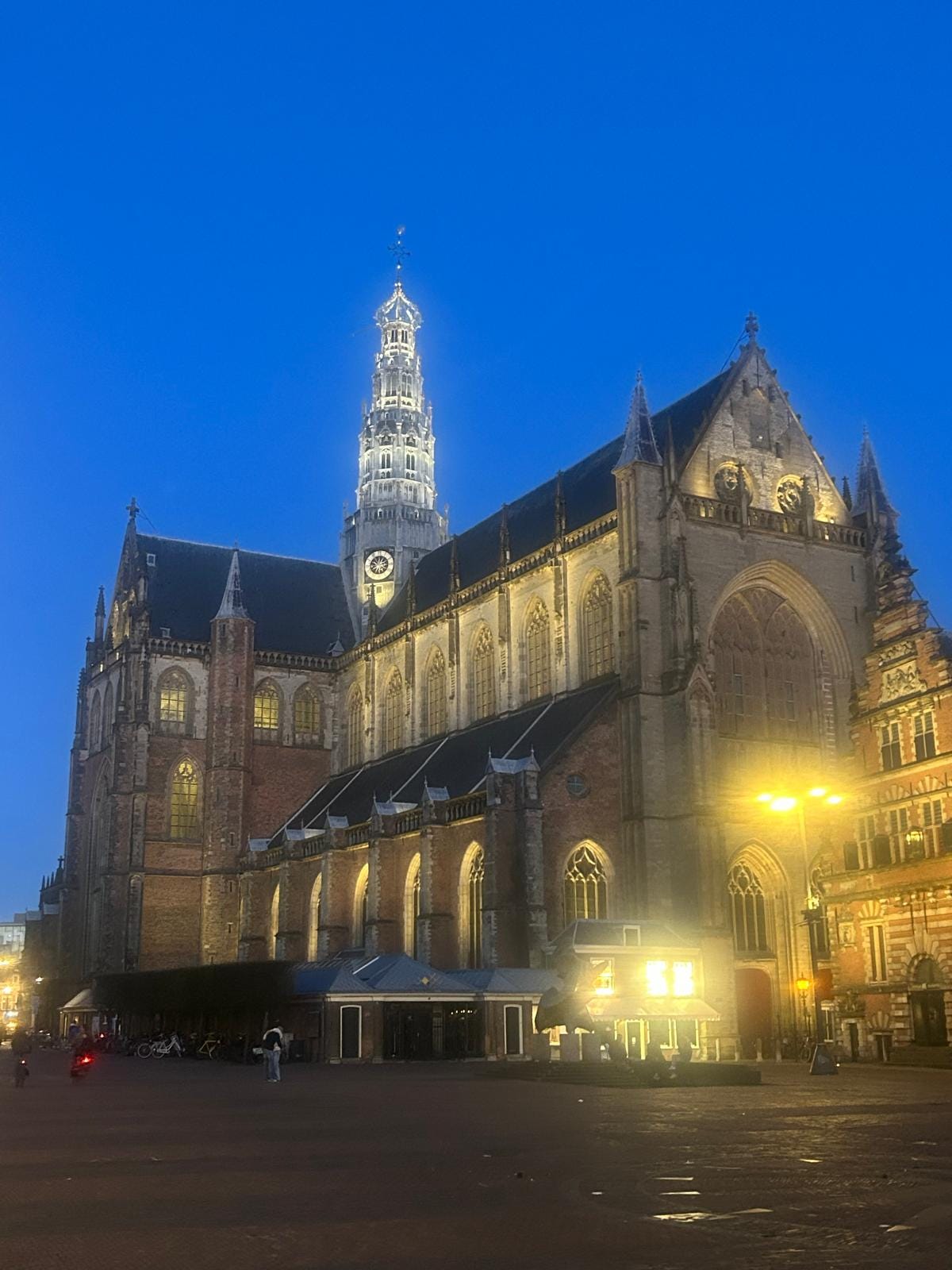
Each night at 9:00pm, they rang and rang.
I imagined people hundreds of years ago orienting to that sound—perhaps feeling called into something larger than themselves.
A collective attunement.
A remembering that we coexist within something vast and mysterious.
A way of centering not just the self—but the field of life itself.
And of course, we contract too.
Moments later, I found myself thinking with feelings of anxiety:
“I need to get back before it gets dark.”
So what creates that sense of separation?
Between the universal and the personal?
How do we begin to recognize the patterns that lead to suffering—when we center ourselves too tightly… or even when we center something “greater” in a way that disconnects us from our lived humanity?
This is where I find myself turning again to the Buddhist wisdom tradition—and to the Pāramīs.
Generosity (Dāna) – loosening the grip of self-centeredness
Morality (Sīla) – aligning actions with clarity and non-harming
Renunciation (Nekkhamma) – discovering the freedom of letting go
Wisdom (Paññā) – seeing the nature of experience more clearly
Energy (Viriya) – sustaining practice with steady effort
Patience (Khanti) – building capacity to stay present through difficulty
Truthfulness (Sacca) – practicing honesty with ourselves and others
Resolution (Adhiṭṭhāna) – strengthening commitment to the path
Loving-Kindness (Mettā) – cultivating goodwill toward all beings
Equanimity (Upekkhā) – developing balance in the midst of change
These qualities—when practiced—may guide us toward that sense of freedom. Toward an “other shore” that reminds us our interconnection runs deep… perhaps even touching something timeless. And maybe, just maybe, they also offer very practical support for how we live together—right here, in our daily lives.
If the universal and the personal are truly connected, then it makes sense that these qualities could bring freedom not just “out there”… but here and now and together.
The practice can become:
How do we live in a way that remembers this connection—especially when we feel contracted, conflicted, or separate?
Over the next 11 weeks, I’ll be hosting 2 cohorts on this topic in the Pragmatic Dharma Sangha.
To orient toward something larger.
To sense into this “other shore”…
And to live into the Pāramīs.
We’ll explore them both as expressions of universal qualities and as practical keys for living in relationship—in sangha, at a deep level… even in the midst of difficulty or conflict.
This is my hypothesis and I invite you into the experiment.

If you’d like to check out The Ten Paramis–without yet becoming a member of the Pragmatic Dharma Sangha–you can join the 1st session on either Wednesday, April 22nd or Thursday, April 23rd.
All are welcome to come and see.
 | A guest post by
|