

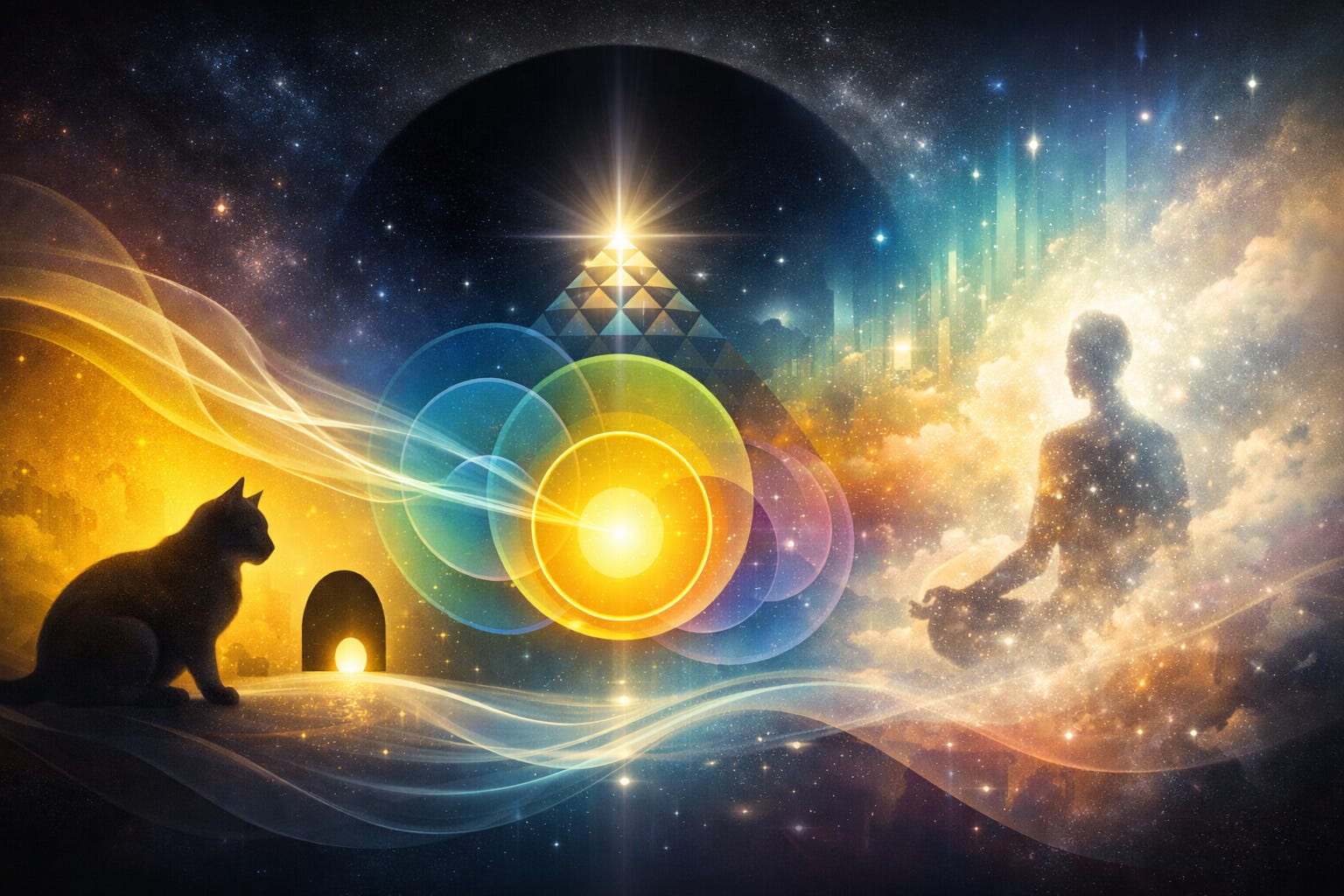
In “Shamatha Jhāna 101,” Brian Newman dismantles centuries of disempowering propaganda about deep absorption, reframing jhāna not as a one-in-a-million attainment, but as something as natural and accessible as a cat watching a mouse hole.
Practice with us: Brian is leading a 12-week live series on Shamatha Jhāna 101, beginning in late February, in the Pragmatic Dharma Sangha.
💬 Transcript
Brian Newman: Everything in Buddhism and meditation has what’s called a proximate cause, which is fancy language that means the thing that comes first. And so the proximate cause for all of us to have suffering would be that we were born, you know, we got born and therefore suffering was part of existence, so we suffer. Ricky, what’s the proximate cause for concentration, do you think?
Ricky: Attention:
Brian: Attention. That’s a great answer. Some people, I’ve heard people say focus. I’ve heard people say attention. In the tradition, what we say is that “concentration is the proximate cause for concentration.” As silly as that sounds, the thing itself is what causes more of the thing. And so we did a little check in there and Siobhan was zero, but then she went to one in like 10 seconds and I’m guessing, many of you, as I was sort of saying, I was deliberately saying that the word concentration, kinda like I’m like hypnotizing you into concentration, the concentration got a little bit deeper didn’t it? So quickly. So it seems that just the intent to concentrate can cause concentration and a little bit can be turned into more.
So this is a really important first lesson for us about what the proximate causes for us getting concentrated are. What I haven’t done yet is welcome you, and it’s really important to me to welcome you all into this room. Many of you who I’ve met before and been through my whole Shamatha Jhāna course, so I’ll try to find ways to say things a little bit differently for you today, but also several of you who I haven’t met, and maybe you’re new to the community, if you are new to the community, want to truly welcome you. It’s a rare thing to be really welcomed to a place.
I’m teaching Shamatha Jhāna, which is a specific focused type of jhāna, while Vince is exploring all the different jhānas here with you. My Shamatha Jhāna class will be starting later in February, so you have plenty of time if you’d like to take that. My practice background is something like 15 years, mostly in that time has been in Asia where I was living.
My wife is Japanese, and I spent a lot of time in China and Japan and had the good fortune to practice with teachers in Asia, as well as some in America. My particular version of jhāna practice is the Pa’auk tradition, which is considered the most rigorous and the most concentrated we could say in the tradition, we would say the most absorbed, the hardest absorptions.
I’d love to start today to talk about some of the disempowering propaganda that is going to potentially be an obstacle to you becoming a master at concentration. And this stuff is kind of all over in the tradition, and it’s quite subtle sometimes, and I want to point it out and I want to really sort of question it here right at the beginning.
Concentration meditation for the purpose of our discussion today is simply the act of applying all of one’s attention or focus or awareness or whatever word you like onto one object, we could even say one point. If I stared at my headphone case for a prolonged period of time, I might enter jhāna. In fact, I’m sure I would enter jhāna.
It’d have to be a pretty long time probably, but this would work just fine to enter jhāna. Paradoxically, when we say putting all of one’s focus on one point, that one point can include every possible point. So it’s not necessarily small. We all think, we often think concentration needs to be small and tight. It can be vast, expansive, and boundless as well, as long as it’s just one thing, not many things that we’re focusing on.
In vipassana practice we focus on what’s arising in our experience, so the mind moves to capture what’s arising. This only produces what’s called ‘momentary concentration’. In a single pointed shamatha practice, we get to ‘access concentration,’ which is harder than momentary, and then we get into full absorptions where the only experience that one has is the actual experience of the jhāna in itself. All the other sense doors have gone away.
So some of this disempowering propaganda that I’d like to nip in the bud here is, first of all in the Visuddhimagga, which is a commentary about the Suttas, because the Suttas are very sparse. The Buddhist suttas don’t really tell you what to do. They kind of point to some vague stuff. The commentary that Visuddhimagga written about a thousand years later has lots of specific ideas about how to do these practices. The Anapana and concentration, the Pa’auk system of which I’m part of is taking this direction from the commentary, the commentary tradition, which came a thousand years after the Buddha.
So imagine that the Buddha was around and then his talks got recorded at some later date. And then for hundreds and hundreds of years, a bunch of really serious practitioners were probably living in caves or monasteries, and they were trying to one up each other on who could get the most concentrated.
That’s what the Visuddhimagga would produce, this massive book that’s essentially saying you think you’re concentrated. Let me tell you what real concentration is. And then somebody else, like, You think you’re concentrated? Let me show you what this really is. Just kind of taking it as far as it could go. So it’s sort of like if you’re going to aspire to something, the hardest thing within Shamatha Jhāna, you would go for that tradition, the Pa’auk tradition.
So here’s what they say in that tradition about the ability that, uh, the ease with which one can enter jhāna.
“Now, the preliminary work is difficult for a beginner and only one in a hundred or a thousand could do it. The arousing of the sign is difficult for one who has done the preliminary work and only one in a hundred or a thousand could do it. To extend the sign when it has arisen and to reach absorption is difficult, and only one in a hundred or thousand can do it.” And so that was just sort of, it’s difficult in the beginning. It’s difficult in the middle. It’s difficult in the end, which is in great contrast to what we often hear in Buddhism, which is good in the beginning, good in the middle, good at the end.
The Visuddhimagga is kind of harsh here, isn’t it? If you do the math on that, it comes out to about one in a million. So it’s saying only one in a million people could possibly get fully absorbed into this thing, that’s the best concentration thing ever.
It turns out that this is patently not true. Patently not true, first of all, because many of the people on this call have access to jhāna. I know because I’ve worked with them and they were one of 10 people that came to my class, so they weren’t one in a million, you know, they were one of 10 that showed up to take a jhāna class.
It is also widely known in Burma where the Pa’auk tradition originates from. Pa’auk was a Burmese monk and uh, has a monastery there. It’s widely known that the Burmese lay people get jhāna in like two weeks. Here’s what happens: In Asia, there’s a great reverence to the teacher, and one simply does exactly what the teacher says.
And the teacher often will give guidance about how to live your life, who you should marry, what profession you should be. And it’s very normal for a Dharma teacher, a Buddhist teacher in Asia. And so one just does what the teacher says. In Asian cultures, the teacher is widely respected. It would be very contrary to not do what the teacher says. So you show up at the Pa’auk monastery, you can be a lay person. The story that I hear is often about lay women who are housewives. So they’re not—the husband is working, the woman is a stay at home mother. And at some point the kids leave home and the mom’s like, I want to go do some practice, shows up at the monastery and Pa’auk Sayadaw offers the instructions, which are the only instructions ever for this jhāna practice, which are focus here.
The simplest thing, the only instructions ever. You can come take my course. We’ll spend 12 weeks unpacking focus here. We’ll spend 12 hours on focus here. The simplest thing. The lay people, the lay housewives are like Pa’auk Sayadaw, who we love and revere and he’s a teacher and he’s clearly the most trained monk in all of Burma.
If he tells me to focus here, yeah, I’ll just focus here. And they just focus there. And then two weeks later they have jhāna. This is like widely reported and widely known. They have very little hindrances to their practice because of their faith. Guess what happens with the Western practitioners who make the trip to Pa’auk monastery?
We can all kind of guess, can’t we? The teacher says, focus here. And then for all of the next teacher interviews, the Western practitioner will psychologicalize focus here, and they’ll talk about all the reasons why they can’t focus there, creating vast stories about their past, present, and future. To talk about what the teacher—rather than simply talking about the practice of focusing here—all of that papancha, discursive thinking, detracts from jhāna.
And then it takes 200 years, or 20 years, or 14 years to get jhāna where the Burmese housewife got it in two weeks. Other disempowering beliefs. Brian, you’re really good at jhāna because you have a special talent for concentration. I don’t think so. I don’t think so. I might have a high pain tolerance.
I’m not even sure about that, maybe. Maybe I have a higher pain tolerance or something, but I don’t think so. I think it’s just time in the cushion. Other disempowering beliefs. This practice requires heroism, heroic practice. You must do really, really hard things to make it happen. I don’t think so.
It’s the simplest thing. You just focus here. Is it hard for you guys to do that in this moment? Just to focus here?
What’s your concentration level right now? If you’re going to scale it after 20 minutes of talking about concentration?
Other disempowering beliefs...
This requires past life paramitas. Past life paramitas are good, karmic actions that you’ve taken in previous lives that got you into this room today. I don’t remember my past lives, so I’m not sure if that’s true or not, but I think it’s magical and fun to think that way.
If past life paramitas were a thing, everybody that’s on this call right now has them, has great ones because you made it into this room to talk about the Dharma with me and Vince. Congratulations, how wonderful. This is so wonderful. Or maybe they’re not true. I’m not sure. But they’re definitely not required for jhāna.
Other disempowering beliefs: You must have perfected ethics. Your sila is the first training. You gotta nail all the sila stuff. Get that really pinned down, nailed down, perfected. And then, and only then can you progress to the next training, your concentration practice. No, it doesn’t work that way. In fact, the concentration practice of jhāna as presented in the Shamatha Jhāna way that I’m talking about, that is the ethical practice also.
That is the practice of ethics. This is called the Path of Purification, as all of us know, because you’re all meditators here, we sit down, we close our eyes, we try to focus on the simplest thing, focus here, and then a lot of other things tend to happen, don’t they? And the mind will go to where it often goes, which might be lust or greed, or tiredness or aversion, or just general lazy procrastination, or Twitter or Reddit or wherever our sort of poison of the day is.
If we had no hindrances, there would be no obstacle to concentration, right? This is the simplest thing. It should be really, really easy to do.
So, because the mind doesn’t go so cleanly to the object, and it does spin to all our preferred poisons, it teaches us exactly where the hindrances are, and if you like this language or not, some people don’t like the language about purification, use your own words for it, but it teaches us where we need to be purified.
It teaches us the work to do, so to speak. If we always flip over into angry rage against ourselves instead of focusing here when we’re trying to focus here, it might be a good idea to talk to a therapist about anger issues. We’re getting taught the psychological work to do. This is the path of purification, this does produce the good ethics, by doing this practice. Two more beliefs that you’ll hear from different jhāna teachers are if you’re not fully absorbed, it’s not jhāna. So that would be an incredibly binary way to think about it. This is jhāna, this isn’t jhāna. And that would mean that on a spectrum of zero to a hundred, there would be a flipping point where it flips over to jhāna.
Are you guys aware of anything in life that’s binary like that? I’m not. I think it’s all just happening on a spectrum. You’re like 10 jhāna, or you’re like 80 jhāna. You’re like a 100 fully absorbed jhāna. And then finally the idea that jhāna must be practiced in a linear order, 1, 2, 3, 4, 5, 6, 7, 8.
No, you can cold start right into different jhāna. In fact, some of you will find it’s easier to get into a third jhāna than the first. Depends on your personal predilections in your idiosyncratic system.
So what if none of these disempowering beliefs were actually true? I don’t think any of those are true. We’ve all heard this like really difficult to get, get absorbed or get jhāna, I don’t think any of that is true at all. I’ve been investigating this for 15 years. And what if your mastery of jhāna simply obeyed some natural laws?
That’s what I’d like to propose to you today. The primary law being mastery of jhāna comes from doing a little bit more than everybody else.
Maybe a little bit more interest. A little bit more effort. A little bit more care towards the jhāna than anybody else. That’s what master is. We’re not usually born saints. We’re not usually born perfected, mastery based natural laws. Because I have so many people that have been through this with me before. I want to talk about this in a sort of a different way.
And part of this is to help you frame it for yourself, but also to help you frame it for other people when they say, “Hey, what are you doing on a Monday at 11? You’re like, I’m doing this Shamatha Jhāna. And they say, what’s that? And then you can talk about it. You can kind of teach people three different metaphors and it’s nice to have different ways to talk about stuff.
So I’ve been reflecting on the animal kingdom, and as Ben knows I like cats. Ben and I co-created the Shariputra’s Cat, which has become a lovely meme in this community. I think cats are also wonderful symbols of concentration in our natural world, and their ability to phase shift is quite remarkable.
So a cat can be walking along. I just saw this two days ago actually, I was watching a cat chase a bird, and it goes from just kind of naturally walking on to immediately crouched, pounced, incredibly still, and highly alert. Perfectly poised, totally still. And it can hold that position sort of indefinitely until it decides to move.
So I have a little slide I’d like to share with you here.
So this is AI rendition of Tom and Jerry, y’all remember Tom and Jerry, right? The thing that I think is kind of funny about this is if you’re a cat one-pointedness isn’t an attainment. It’s how you get dinner.
The posture of this cat isn’t soft, receptive, receiving, blissed out. It’s definitely not Fat Buddha. It’s not Fat Buddha. Fat Buddha is super chilled out. This cat is coiled, alert, poised. Can you see? Often in the Tibetan traditions they call—they call—they talk about the dancing stillness or the vibrant stillness.
Can you kind of see that in the poised cat there’s movement somehow even in the stillness. And then the object of this cat’s practice is the hole. How long will the cat stare at the hole?
I think the answer is until the mouse comes out. So some of you like Mark, who was with me recently on retreat, when you’ve heard about the nimitta, it’s kind of a nice metaphor, isn’t it? We would just look at it until the nimitta arises. The nimitta is a mind generated object that appears in your mental space if you do a lot of concentration practice.
So the reframe that I’d like and that I’m presenting with the cat is I’m reframing the motivation of why one would do this sort of single pointed practice. So this kind of changes from, I think meditation is something good and I should probably do it, I think it’ll probably have some benefits in the long run — or maybe even like before that, why should I meditate?
Kind of an open question, like, what’s the point? Vince is really good at this. Like, sort of framing that around what’s the point? Why, why are we meditating? What if we change that to, what are you hungry for? Like the cat is hungry for the mouse.
What’s the object that would encourage you to concentrate that hard?
Bitcoin coming out of that hole? Little bees pouring out, or gold coins or silver coins? Silver’s having a run right now, or would it be like a delicious beef bifana? Ben, Mitch and I were eating delicious bifana sandwiches in Portugal recently. Or could it, would it be like, you know, like Miles Davis would come out of the hole and that would be good enough for you to sit there and stare at it for four hours with nothing happening?
Knowing that was going to happen.
It turns out that choosing the object, so in this case the, it’s the hole for the cat. It turns out that choosing the object is incredibly important. And In the tradition that I’m talking about, the Pa’auk tradition, the object that we use is the breath.
In many concentration practices, across traditions, the object that’s used is the breath. The reason for that is often said that the breath is easy to use for an object because you always have it with you. You don’t have to carry things with you. It’s always there for you. But it turns out that there’s 39 other objects that are known to take you into jhāna.
I encourage you all to sort of consider that. If you come to Shamatha Jhāna with me, we’ll be working with the breath, but I encourage you to consider that. What’s my mouse hole? What’s the thing that would be compelling enough for me to spend a long time waiting for something to happen? Jhāna is a lot about waiting.
It’s about faith, persistence and letting it come to you when it’s ready. Nobody ever really reached out and grabbed jhāna, jhāna showed up for them.
Just to give you a little hint of what some of the objects are, and Vince is going to get really deep into this over the next 10 weeks with you all, you have different colored shapes.
So these are called kasinas, and they’re signs. You could have a red one or a blue one, or a yellow or a white circle that you would stare at. And that’s why I say if you stare at your headphone case for 10 hours a day for two weeks, this is just another version of a kasina. It’s a white kasina. You could just stare at it and you would get really concentrated and maybe after two weeks you would get drawn up.
I think many people that would happen for actually.
So maybe you’re an artist and you’re drawn to colors. Yeah, think about kasina practice. Maybe you’re a Sky dancer or a Shaman in training and you’re drawn to the elements. Think about the wind and the fire kasinas and the water kasinas. Maybe you’re really a heart-centered practitioner. It turns out that the Brahmaviharas, metta, mudita, karuna, upekkha, compassion, equanimity, sympathetic joy, these all produce jhānas. Those are part of the traditional 40 objects meditating on the body. So hair, nails, flesh. And specifically the foulness of the body is a strong concentration object. So plus blood, bile, feces, urine.
These are all part of the traditional 40 objects. Now, many of us would sort of wince at that and be like, why would we meditate on foulness of the body? In fact, in the monasteries where I practiced in Asia, they have books to help you do this. And these books are cadavers that have been cut up and they’ve taken pictures of them for the sake of the Buddhist practice, and they’re held in these books, and you’re meant to look at the picture, you know, really study it and then set it aside, and then you do the meditation with that mental image.
These are pretty hard books to look at. Now, why would anybody do that? Why would anybody choose to meditate on foulness of the body as their preferred object? Anybody have an idea of why that would be done? Feel free to drop it into chat, or if you’ve got an idea, you can just come off mute and say.
Look at those other more pleasant subjects — what about lotuses, roses? It attenuates lust and attachment to the body, exactly what Benjamin is saying. One of my teachers, Steven Snyder and uh, Tina Rasmussen were a married couple when I first met them. They since divorced, but when they went to practice with Pa’auk Sayadaw for the first time, they had just gotten married.
He had them face each other in the meditation hall and meditate on the foulness of each other’s body, what that practice is like. I’m, I’m going to be a little bit explicit here now, not because I’m getting off on it, but because I want to be super clear what that means. It means that Tina would look at Steven and then reflect fairly deeply on his feces and where they come from and the repulsiveness of that over and over and over again for hours and days on end for the newly married couple. Just kind of take that in, like, Wow. So Pa’auk Sayadaw, who knows why he offered them that practice, but maybe he saw something, there was some attachment.
He wanted to sort of send a message. I also don’t know Tina had just taken robes at that time. She’s since disrobed, she’s not a monastic, but maybe they were in the celibacy thing anyway, so that might’ve been a way for them to, you know, keep the celibacy tight or something. I don’t know the reasons.
And then finally we have fancy objects, fancy things that we can meditate on to fill out the list of 40. Some of those fancier things. The breath would be one of them. I call the breath fancy because it’s nuanced and there’s a lot of complexity to it.
In jhāna practice as one of the 40 objects, we take the breath as a concept. It’s not looking at all the subtle sensations of the breath and noticing all these things about it like we would do in Vipassana. We’re simply noticing the breath coming in and out as a concept. Breath, like everything is empty, we’re just assigning words to some sort of thing that’s happening, and we’re noticing that and not vipassanizing it and just letting it be sort of a concept.
Other concepts that we could meditate on would be impermanence. Some people might consider that a perennial truth rather than a concept we could meditate on, the Buddha. We could meditate on the Dharma and lots of other things.
Then there’s stories that break all the rules in the tradition. For example, one of the ones where the Buddha meets a person who he can see was a jeweler in the past life and knowing that person’s love for jewelry in the past life, the Buddha offers a Red Ruby or a Sapphire as a concentration object. And so that you could call that the 41st concentration object, but what that really means is any concentration object could work, most likely. It’s just that we sort of have a documentation around 40 traditional ones.
So back to that question for you, if you’ve tried jhāna practice before and you’ve thought, oh, the breath is boring, or I find it too dry, or, I really prefer the pageantry and craziness of the Vajrayana Tibetan tradition. Then what I encourage you to do is find an object that suits you. You know, take the fire kasina or pick something else that has a little bit more vibrancy to it, and that that might solve your, your dilemma of dryness in the practice.
What I’ll close this out on is just some of the things that one can expect from doing this practice. The first thing that you can expect to happen is that the simplest thing ever, focus here, turns out to be not so simple.
And so I’m saying that to normalize the difficulty that many people have in doing the simplest thing for some of the reasons I mentioned earlier. So it turns out the simplest thing’s not so simple, but the mind stabilizes over time. The next thing we can expect to happen is you’re going to start to get really good at darts.
You know, you go play like that game you play with darts and beer or whatever. You know, those bar games. Darts, pool, golf. Anything where you’re needing to focus on something with some clarity and then hit it or do something with it. I’m kind of joking here, but there’s these practical applications to jhāna practice, which you can start to see things really, really clearly.
I noticed in my practice that it built up, in the very early stages it built up my ability to work in Excel spreadsheets, which is not something that I love to do. It’s not my strength. I built up the ability to do it for very long periods of time or anything like desk work, whereas usually I’d kind of burn out after 45 minutes or an hour.
I would have to start to set timers to even remind myself to go to the bathroom and take bio breaks, because my concentration got so good. I don’t know if this is a good or a bad thing, I was sort of disconnecting and getting sort of disembodied, you know, because my concentration was so strong. But it’s pretty cool to go from, oh, I’m so tired of looking at this Excel to, you know, spending six hours at it and not feeling fatigued or tired at all.
I can say lots of other sort of like silly lay outcomes, but they’re not that silly. These all produce really, really nice improvements in quality of life. Here’s another one that I just thought of. It allows you to sit with another human being and not look away. Many of us are really, really bad at eye contact.
We flinch and we look away. Because you’ve stabilized the mind, you’ve stabilized the eyes for the practice of the system, you can just sit there and be with someone in a non-penetrating way, in kind of a nice way, and you’ll notice that about yourself. You notice that you stop flicking away, which we often do sort of subconsciously when our mind is not stable.
Our simple nervous system is broadly governed by a sympathetic and a parasympathetic response. Sympathetic is things that make us active, so drink some caffeine, activate the sympathetic response and get kind of, um, excited or energetic. Parasympathetic is the rest and digest system, and so this is what we feel after a big meal.
After making love, that sort of happy, drowsy feeling. It turns out that the parasympathetic system—well think about that for a moment. So sympathetic is highly activated. What would you do if someone was really highly activated like they were having a panic attack? If you see somebody at a Starbucks and that person just starts to have a panic attack,
most of us would probably go over, maybe we’d lay hands or we do something and we’d probably say some version of, “Breathe deep, take deep breaths,” something like that. Why would we say that? Do we even know why we’re saying that? It’s an intuitive human thing to say. By taking a deeper breath and exhaling longer, we’re holding more carbon dioxide in our body.
Carbon dioxide has a parasympathetic stimulating action to it. So it turns out that we tell somebody to take deep breaths, we are getting them calmer through the withholding of carbon dioxide. The same thing happens in meditation, and so jhāna practice is known to be blissful. This is going to produce really, really amazing things, incredibly esoteric, blissful factors of jhāna that I won’t talk about in detail, but I’ll hint at today.
One of the reasons these things arise, and one of the reasons our whole system and central nervous system gets regulated is because we’re slowing down our breath naturally. We’re not doing it on purpose. It just starts to slow. All of you in the room, I suspect, are meditators. It’s interesting to clock your breath sometimes, see what your breath rate is.
I predict for those of you who’ve been doing this for some time, you’re probably breathing five to seven breaths per minute. That’s what people tend to stabilize over longer periods of practice and that’s pretty slow. If you were going to try to breathe five breaths a minute right now deliberately, which would be about one breath every 12 seconds, I think that would feel difficult for you.
Maybe you would sort of be forcing, it might even start gasping if you tried to do that right now. But that’s what we settle on. So the slower breathing produces a parasympathetic response. Taken a long way that produces dramatic bliss in the body.
This is also a hint to us, which is if we want to be advanced meditators, maybe we should not follow that rule about not controlling the breath, and maybe we should try to control the breath once in a while to see if we can slow it down to stimulate the parasympathetic response.
I absolutely advocate that, and I’m in the great tradition of Robert Burbea who said, “Don’t control the breath? Control the breath. Breathe with pleasure.” Breathe pleasurably. I stand by that. If we can breathe pleasurably, please do. Other things you have to look for pain reduction as we move up the jhānic arc.
When I say the jhānic arc, I’m referring to 1, 2, 3, 4, 5, 6, 7, 8. We’re moving from gross to subtle. Up the arc, and as we move more towards the subtle, it becomes so subtle that the body starts to dissolve. And by the time we get to the fifth jhāna, which is known as the first of the formless jhānas, there’s no more form.
There’s no more body to experience the world as it is this flesh and bone system has essentially become non-existent in the experience of the meditator. And therefore any ache, pain, sprained ankle, shoulder hurting, tight neck that was experienced up until that point is completely gone, utterly and completely vanished.
What this means is the jhāna master, the jhāna practitioner even has access to OxyContin on demand. You never have to be in pain. Anything can be managed with your breath and your jhāna, including jail, including terrible situations. Pick something, anything that I’ve just said. I would only say if I’ve tested it out,
so everything I’ve just told you has been tested by me as holding up. Sprained ankles, various difficult pains, blood and guts, and jail. All of those are completely nothing when it comes to jhāna. Jhāna beats them. What this means is culmination of the Buddhist path, which has been said to be happiness beyond conditions, and so clearly jhāna is offering that.
The dilemma with jhāna that we need to understand here right at the beginning is that it’s something that we create. The causes & conditions have to be there for it, and that ultimately it fragments and vanishes.
Which can be a hard thing to bear when one has put a lot of time towards cultivating their jhānas. There’s a big, a really important message in the Dharma in that.
And then finally, what we have to look for are esoteric, mystical things that we can experience in our body. We would call these mind generated physical sensations, and these are called the jhānic factors. There’s five of them. The two that probably get the most attention and rightfully so are piti, which is often translated as rapture, which is not a word we use too much.
When’s the last time that you use the word rapture in a normal conversation? But I think you probably know what it means. The French have lots of evocative language and they call this frisson (F-R-I-S-S-O-N), and it means aesthetic chills. It’s that thing you get when you say, “Ooh, the hair on the back of my neck is standing up.”
I have lots of examples of this as you do you, um, one that’s coming to my mind right now is about two years ago. I’m living in Lisbon, Portugal. The Pope, the Catholic Pope, came to town. And Portugal is an incredibly Catholic country, as much of Europe is. And I think this is maybe like the first time he came in a long time.
It was a really, really big deal that the Pope came to Lisbon and I don’t know what they did, but they somehow like wired the city, this entire city, which is about almost a million people, where everywhere you went outside, everywhere I went outside, they had somehow projected the sound of angelic voices singing throughout the city.
And so it was kind of like one would imagine heaven, like I imagine heaven. So I’m in my office, and then I would just like walk outside and there’s angelic voices singing everywhere and I’m getting it right now. Every time that happened, the hair in the back of my neck would stand up and I’d be like, “Oh, this is, whoa, this is so nice.”
And that’s piti. The aesthetic frisson, the little bit of reaction to aesthetic beauty. Something really interesting about piti is just the memory of piti can bring up piti as it is for me here right now, just talking about it with you all. I think maybe the proximate cause for piti is concentration.
And then the proximate cause for piti is also piti. I urge you next time that your friend says, “That made the hairs on the back of my neck stand up,” or the next time that you feel that to take a pause and to notice that. And to steep and marinate in that feeling. Because what you’ve just experienced is a jhānic factor happening in just daily life. To notice that makes it more likely to arise.
And finally, sukkha is one of these five factors. People really like sukkha. This is the promise of jhāna, and when I say it’s on demand, OxyContin. OxyContin is a really strong pain pill. It’s like a drug pain pill that makes you feel really blissed out and euphoric. When I say that, I’m pointing to the sukkha aspect. Sukkha is often described, translated as bliss, and so what, what can I say about this?
In my experience, sukkha is to have the experience of being perfectly held by one’s perfectly ideal mother figure.
And how lovely must that be? Every time I meet it, it always surprises me about how beautiful it is. No matter how many times I’ve felt it.
If you plant a seed, a tree will grow. It is in the nature of seeds to grow into trees. If you focus on your breath at the tip of your nose, jhāna will arise. It is of the nature of human beings to experience concentration. This is not something that you can experience by listening to me talk about it.
And so what’s required at this point in your practice, if you don’t have access to these states yet, is faith. And in the Christian tradition, since we’re talking about Catholicism, the Christian tradition would like you to have faith about the next life, and that’s where you’re going to go when you die, and that’s where you’re going to hear the angelic singing and everything’s going to be really great there.
The Buddhist tradition is an experiential tradition that’s making an offer to you in this life, and it says, if you do this thing, even if it’s not happening yet, we promise you something’s going to happen and here’s what’s going to happen. And the Buddha would always say, “Don’t believe me. Come and see. Just come and see.” If this is interesting to you to maybe come and see what’s going to be required for your faith is to be doing something even when you don’t feel like it’s working yet.
To trust that drop by drop, the bucket will become full, and it’s to have faith in an ancient tradition, and the ancient teachings from that tradition. It’s to have faith in your teacher, someone who has done that practice that can tell you how to do it. It is to have faith in your concentration object, which has been used by human beings for many thousands of years, before the dawn of written words.
But the most important thing is to have faith in yourself and to believe that you can do this practice. And if you just listen to me talk for the last 45 minutes, you can do this practice.
Practice with us: We learn more, when we learn together. If you want to learn together with experienced teachers & driven peers, we’re welcoming new members to the Pragmatic Dharma Sangha.


