
Introduction to Social Noting
The Practice That Makes Mindfulness Inherently Relational

“As long as meditation is defined as sitting silent and alone, it’s not going to catch on. We are human primates. We are social in our very bones.” – Kenneth Folk

Social Noting was originally developed by one of my earliest teachers, Kenneth Folk, a long-time Buddhist yogi & teacher who has spent many years practicing in the Mahasi Sayadaw tradition, under the tutelage of Bill Hamilton, where he mastered the art of Mental Noting.
Kenneth developed Social Noting while attempting to find more effective ways to teach the traditional methods of Mental Noting to his students. He discovered that by doing the practice out loud–traditionally, it was only ever done internally–he could hear how his students were practicing, thus enabling him to give them instant feedback on their technique.
Kenneth also found that by doing the practice out loud, he was able to model the practice for his student’s, giving them the instant benefit of seeing what it’s like for someone with thousands of hours of experience to do the technique. By taking turns noting out loud with his students, what he originally called “ping pong noting,” he discovered a much more effective approach to teaching tradition noting meditation. He also, inadvertently, ended up developing an entirely new approach to mindfulness practice, one that is inherently social.
Noticing vs. Sensing
While there are many definitions of mindfulness, I’ll describe it simply as the practice of noticing what you’re sensing in real-time. Social Noting, then, could be described as the practice of noticing what we’re sensing in real-time. The only real change, between subjective mindfulness and intersubjective mindfulness is the subject of focus. In traditional Mental Noting practice one is focused solely on one’s personal experience, while in Social Noting one is focused on the co-arising of experience between self & other(s). Social Noting shifts attention from a me focus, to a me + we (“mwe”) focus.
“Who we are is both within and between: Me plus We equals MWe, the reality of an integrative wholeness of our intraconnected lives.” – Daniel J. Siegel, IntraConnected
It’s important to point out the difference, in this way of describing mindfulness, between “noticing” and “sensing”. Both noticing and sensing are ways of knowing, but they’re different. Noticing is a way of knowing that includes cognition. To illustrate this, we can do a simple exercise. If you take the time to do this yourself, I believe you will get a clear sense of the difference between noticing & sensing. So to begin with, when you notice the palm of your hands, what is there? Well, in order to find out, we have to check…
There is tingling. There is warmth. There is an internal image of my hands.
There are things which I can recognize, and clearly identify with my cognition. I am noticing my hands. Now, what happens, when instead of noticing your hands, you simply sense your hands? Stop reading this, and take a moment to sense your hands directly.... 🤲
When I do this, and when I’ve seen other practitioners do it, what’s discovered is that the thinking mind goes blank for a bit, as it becomes difficult to describe what we’re sensing with words. The degree to which we’re really able to contact the sensations of what we’re calling “the hands,” itself a basic concept, is the degree to which we become immersed in a type of experience that is non-conceptual & immediate. We are sensing something that we typically relate to as “the hands,” but at a level in which the concept doesn’t appear to be functioning in the same way anymore. We are contacting direct sensation.
“There is a huge debate about what mindfulness is – Is it sensing or noticing? Intention on focusing on breath – requires differentiation of noticing vs. sensing. You use the noticing circuit to disengage the distraction and then use the sensing circuit to re-engage your focus.” – Daniel J. Siegel
The purpose of noting practice is to continually engage the noticing function of mind, to help us investigate direct sensory experience. Once we’ve become lost in sensation–often in sensations related to feeling or thinking–the noticing function of mind helps us to identify that there is wandering, distraction, or forgetting. From there, as Dr. Siegel points out, we can re-engage with direct sensory experience. Mindfulness practice includes both noticing and sensing, working together in a kind of virtuous feedback loop.
The Noting Spectrum
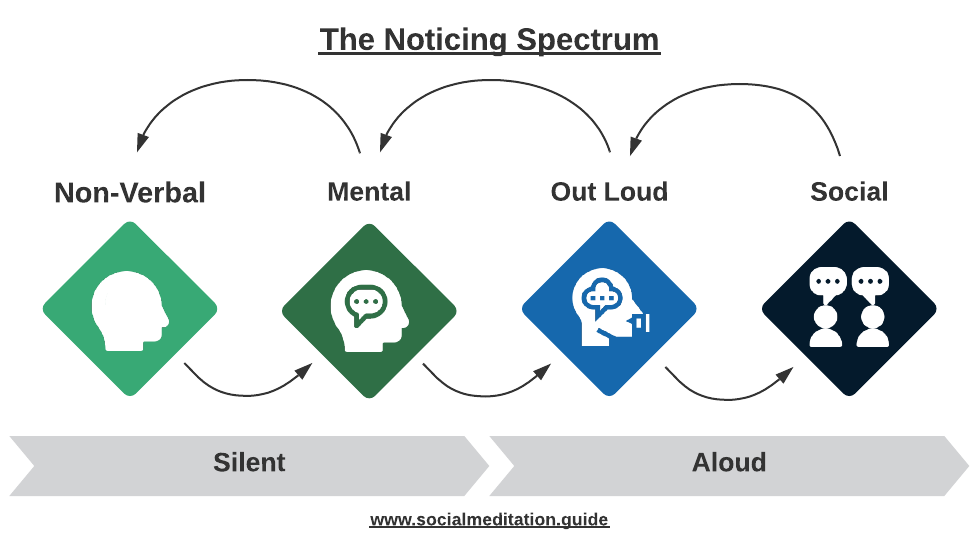
In the practice of noting meditation we often use verbal notes, or what are also sometimes referred to as labels, to help engage the noticing function of mind. One can note silently to oneself–aka Mental Noting–or one can note out loud by themselves–aka Out-loud Noting. Finally, if one notes out-loud with others, this is what makes the practice Social Noting. It’s also possible to drop the verbal notes altogether and practice non-verbal noticing, what has also been called bare attention.
Just as a reminder, the use of verbal notes is always in the service of noticing actual sensations, not in merely categorizing experience. Again, from the point of view of this practice, knowing can take both the form of simple cognitive knowing (i.e. noticing) and direct sensorial knowing (i.e. sensing). Or as insight meditation teacher, Joseph Goldstein put it, the function of a note or label operates in much the same way that the frame around a piece of visual art does. The art frame is meant to draw our attention into the artwork, not to be the central focus. In the same way, a verbal note is meant to draw our attention into the direct sensory experience of seeing, hearing, smelling, tasting, touching, feeling, and thinking. The words are not the experience, rather they’re meant to put you more deeply in touch with your experience! And with the practice of Social Noting, the practice is further designed to not only put you in touch with your experience, but also to help you contact the experience of others–to develop, as Dan Siegel puts it, both inner resilience and interconnectivity.
Learning Social Noting
One of the beautiful things about Social Noting is that it’s a peer-to-peer practice. Because it is not necessary to be guided by someone with decades of experience who has been authorized to teach, anyone can learn to facilitate the practice and do it together with others.
This is how I originally learned the practice from Kenneth Folk in 2010, and for the last several years, I have trained well over 100 people to facilitate these practices and bring them into whatever contexts matter to them:
Into their homes with loved ones
These practices are particularly great for young children, who almost never want to sit alone in silence.
Doing these practice with intimate partners dramatically increases intimacy.
Into the work that you’re already doing
Facilitators, Coaches, Therapists, Teachers, and Leaders have all found it a useful additional to their ecologies of practice.
Anyone can learn to facilitate and practice these techniques in a trauma-informed way. I’m happy to share that I am offering my first facilitator training in Social Noting in over three years, coming up this in March in the Pragmatic Dharma Sangha. It is freely available to all Pragmatic Dharma Sangha members.
I will also be hosting a free Introduction to Social Noting session this Friday if you’d like to come and get a taste of the practice–without necessarily joining our Sangha–as well as learn more about what’s involved in learning to facilitate this incredibly effective & timely social practice.
Practice with us: We learn more, when we learn together. If you want to learn together with experienced teachers & driven peers, we’re welcoming new members to the Pragmatic Dharma Sangha.
Work with me: I have over 15 years of experience being a catalyst for other’s natural process of awakening & integration. Schedule a free intro call with me, if you’d like to connect & learn more.